Designing systems at scale: the definitive microservices guide
From Sam Newman's principles to real code. What they are, what they're for, when not to use them, and which design patterns separate an architecture that scales from one that collapses.

1 / 13
There is a question that appears whenever a system starts to grow: when should we stop adding code to the monolith and start splitting it? The honest answer is that most teams do it too late, or worse, too early.
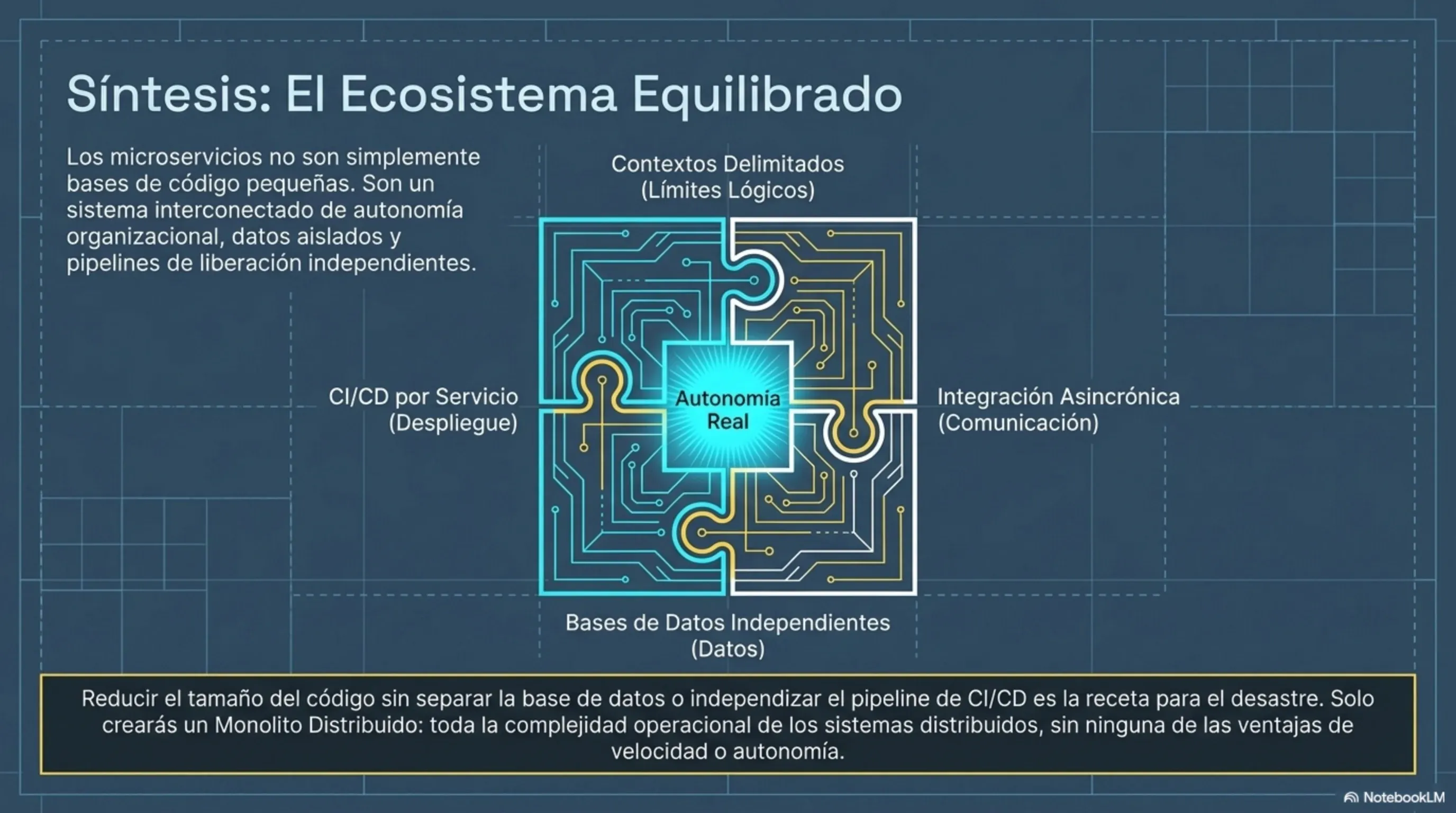
Microservices are not just an architecture. They are an organizational decision with technical consequences. If you do not understand that before writing the first line, you will build a distributed monolith: the worst of both worlds.
This guide condenses Sam Newman’s Building Microservices and applied experience into practical decisions for real systems.
What microservices are
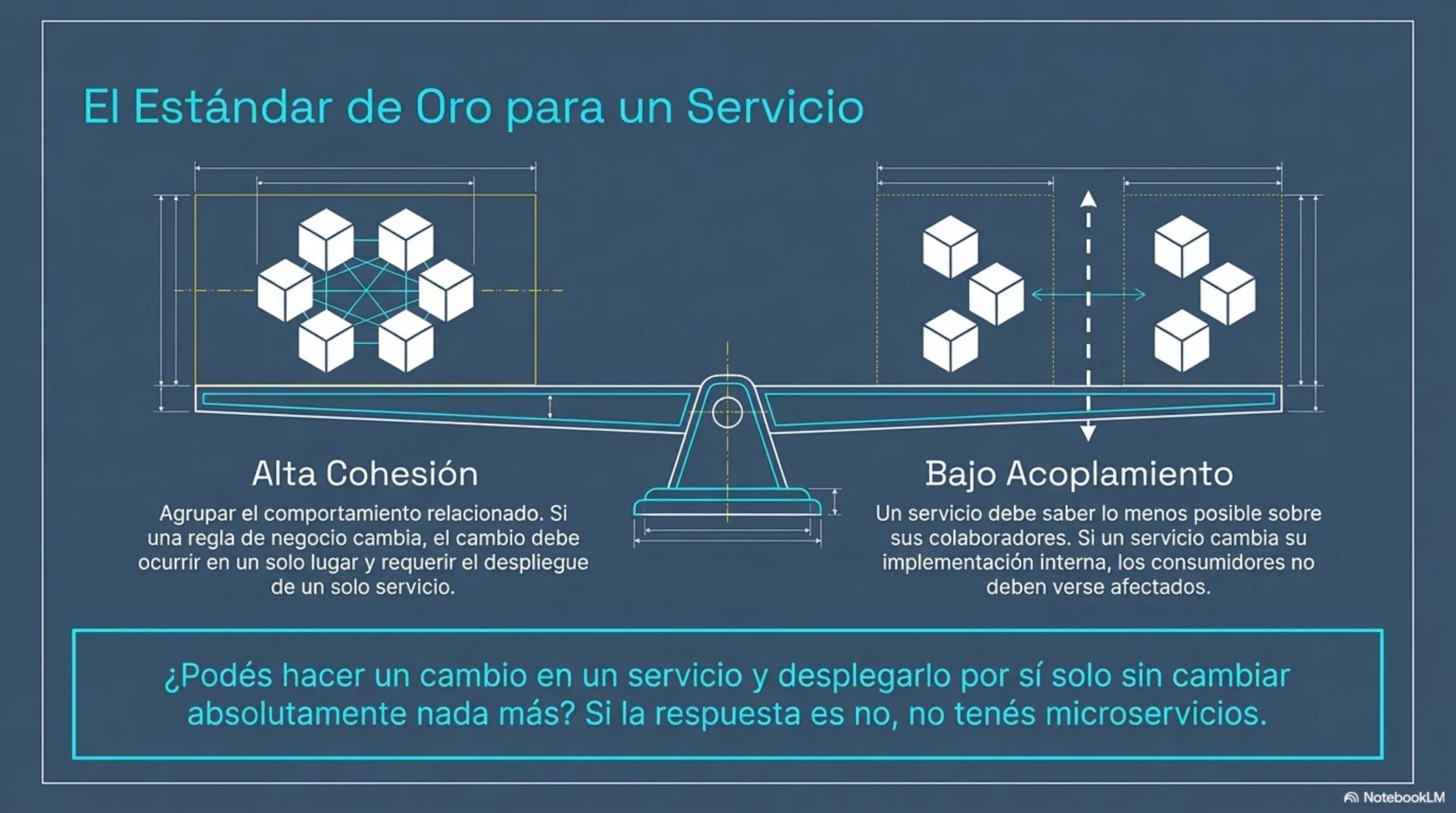
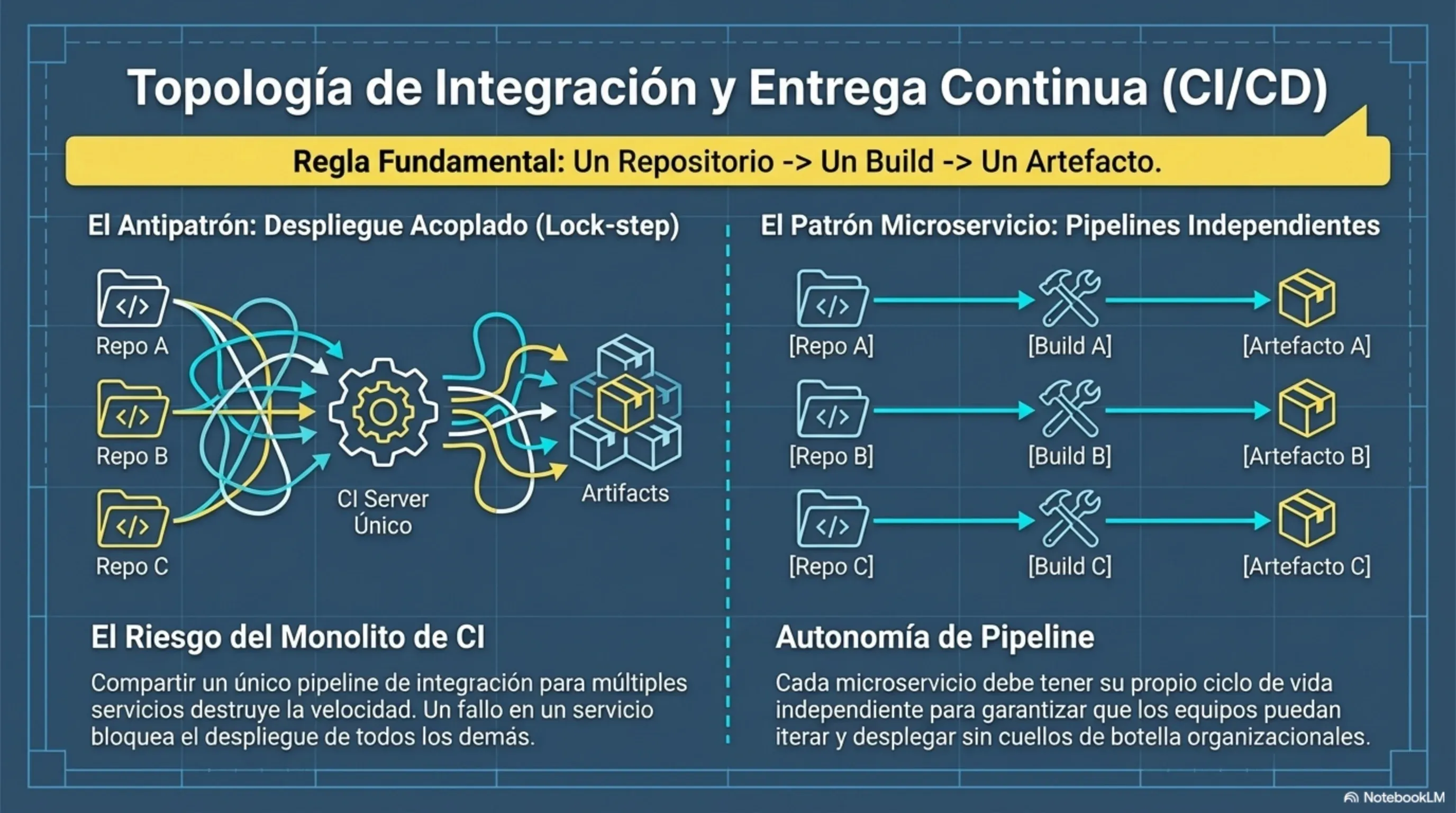
Microservices are small autonomous services focused on one responsibility. Each service has its own lifecycle, repository, deployment pipeline, and database.
The advantages that justify this complexity are concrete:
- Technology heterogeneity: each team can choose the language and database that best solve its specific problem.
- Resilience through isolation: when one service fails, the rest of the system can continue operating.
- Targeted scalability: only the component under pressure needs to scale.
- Independent deployment: teams can release their services without coordinating every change across the whole platform.
The most expensive mistake: decomposing without understanding the domain
Newman is direct: if you do not understand your business domain, do not use microservices. Build a modular monolith first. Learn where the natural boundaries are. Split later.
Premature decomposition creates chatty services: services that call each other constantly, accumulating latency without the cohesion that justifies separation. Refactoring a badly split architecture is far more expensive than refactoring a monolith.
A useful heuristic: a service should be small enough for a small team to rewrite in no more than two weeks. If it takes longer, it probably does too much. If it takes less than a day, it may not justify the overhead of being independent.
The architect as urban planner
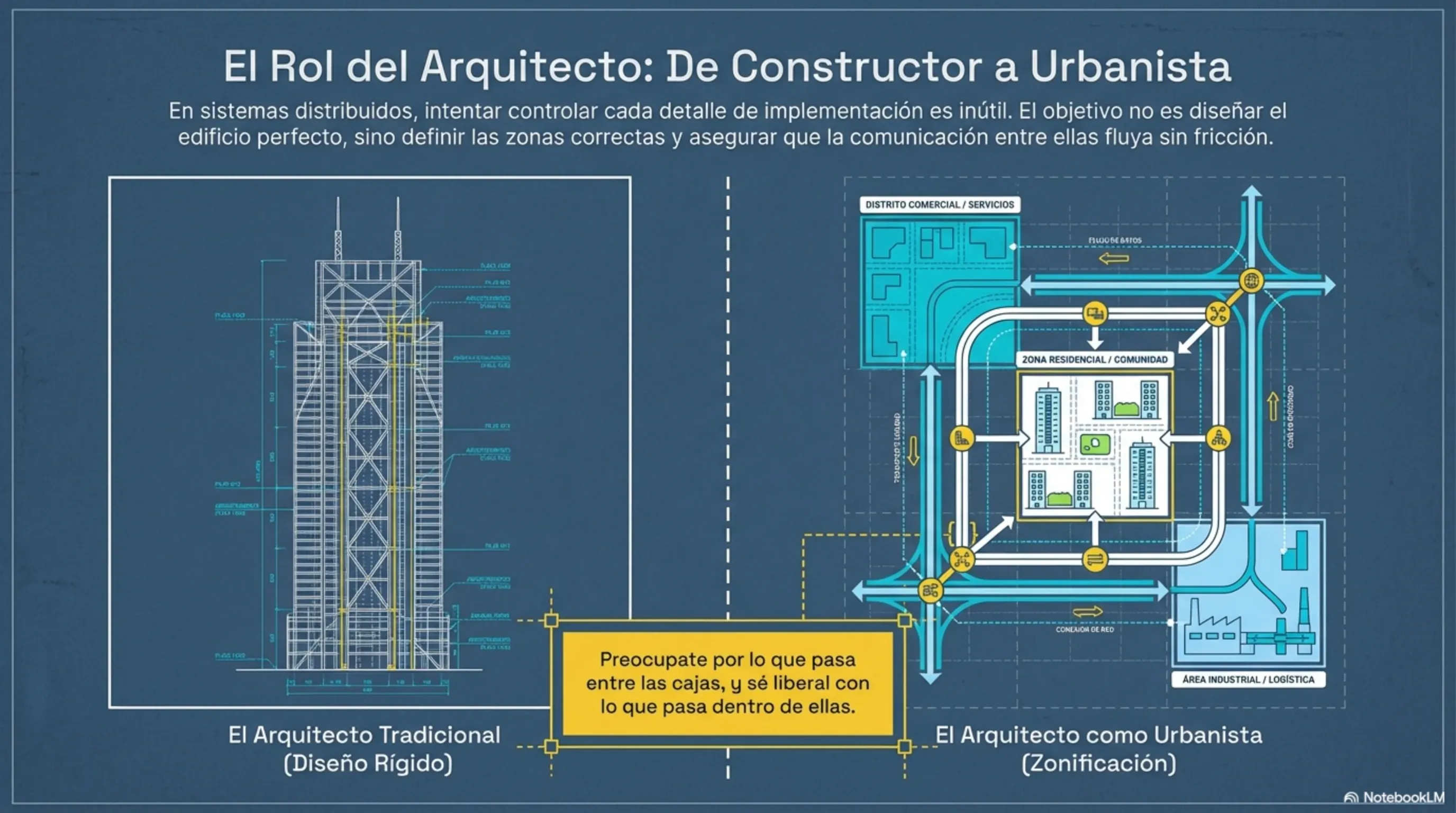
In a microservices ecosystem, the architect no longer designs every internal component. The role becomes closer to an urban planner: defining zones, interaction routes, and standards of coexistence, while delegating detailed decisions to each team.
An evolutionary architect controls the points where services interact: communication standards, logging format, centralized monitoring, and operational expectations. They deliberately do not control each service’s internal technology.
Finding the right boundaries with DDD
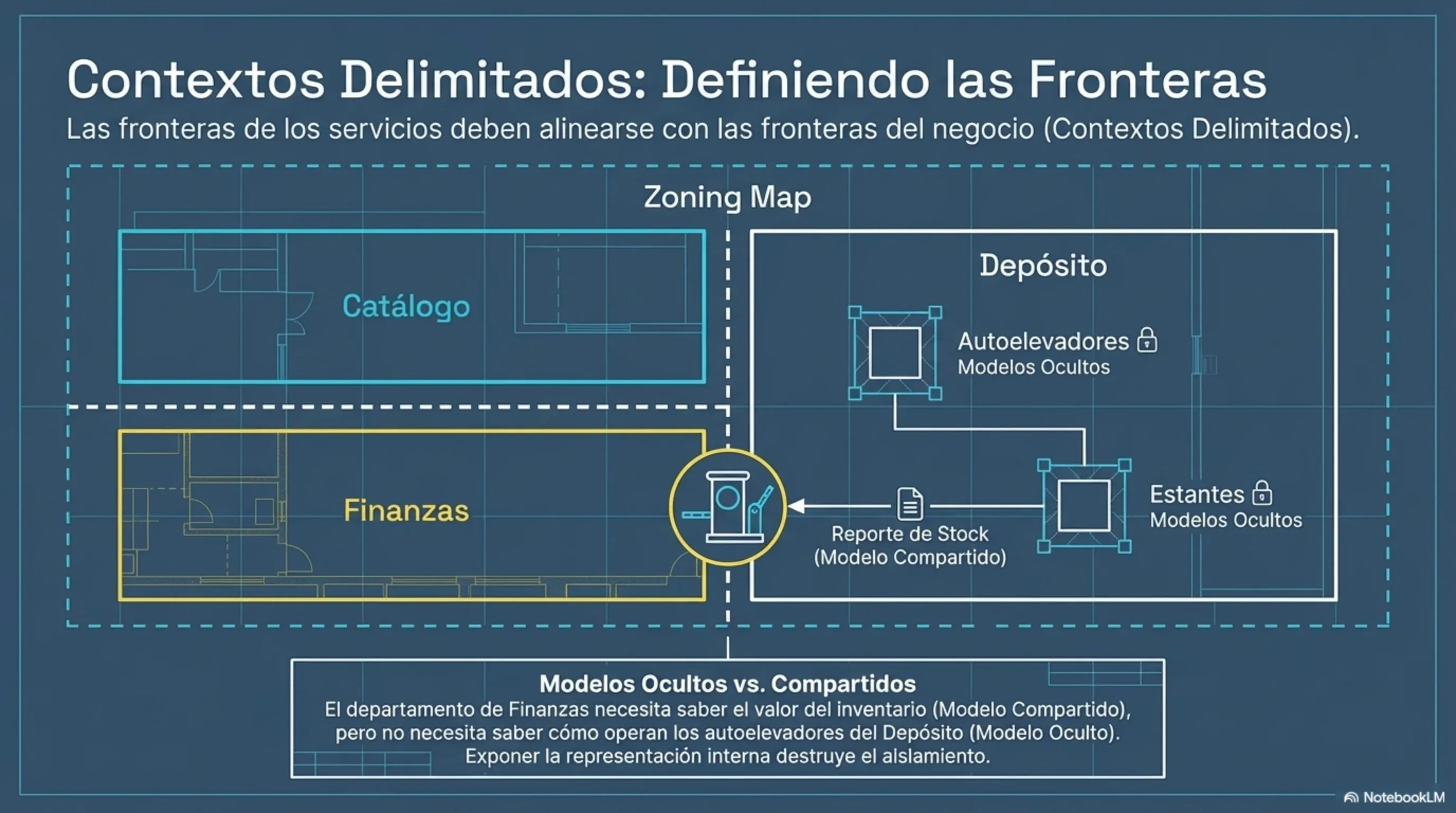
The most valuable Domain-Driven Design concept for microservices is the Bounded Context: a semantic boundary where a business model has a consistent meaning.
For example, “customer” means different things in sales, billing, and support. A single CustomerService trying to satisfy all three becomes an anemic object with optional fields that nobody understands.
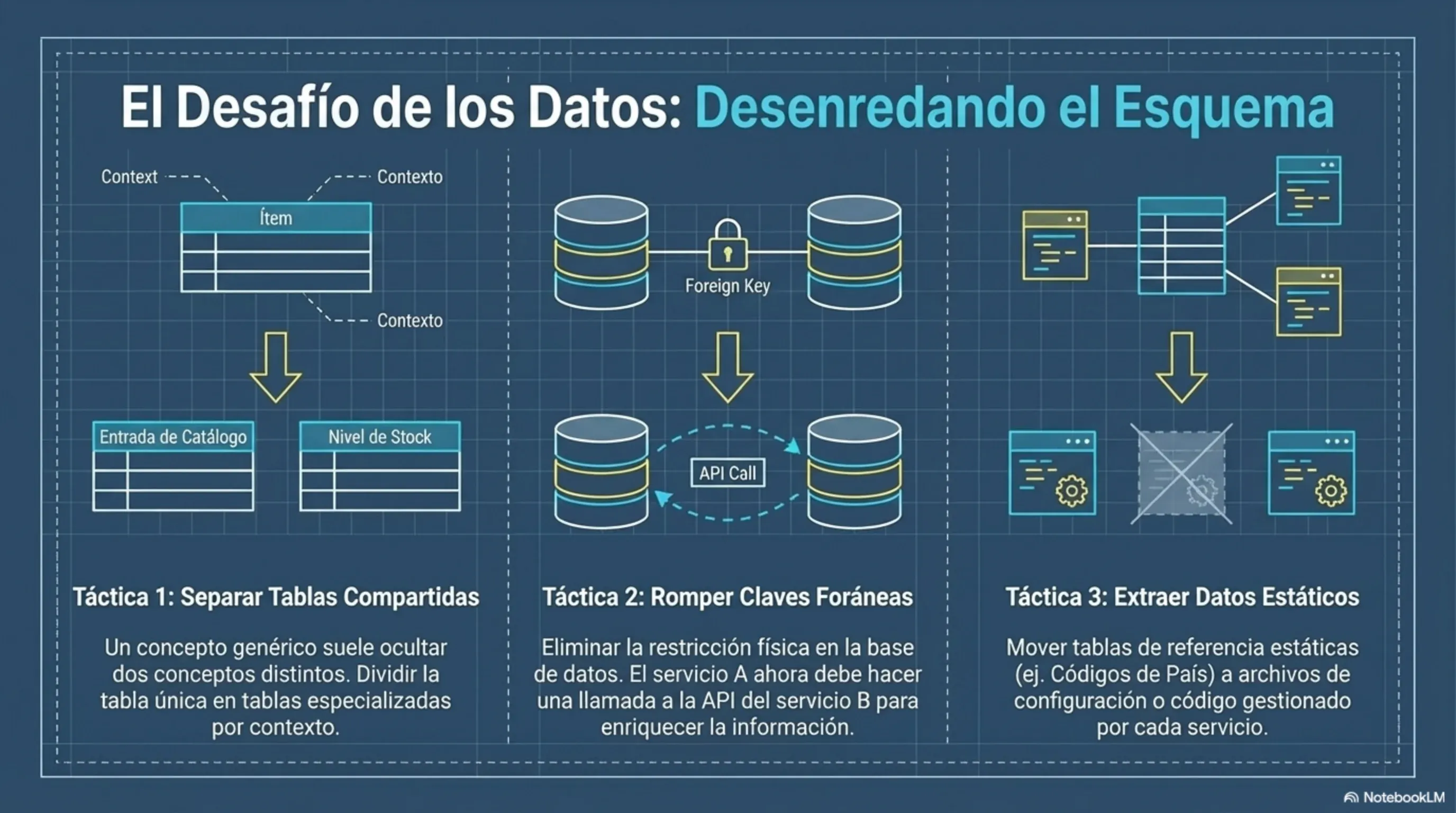
The correct solution is separate services, each with its own model and database. Sales asks billing through an API; it does not share the table.
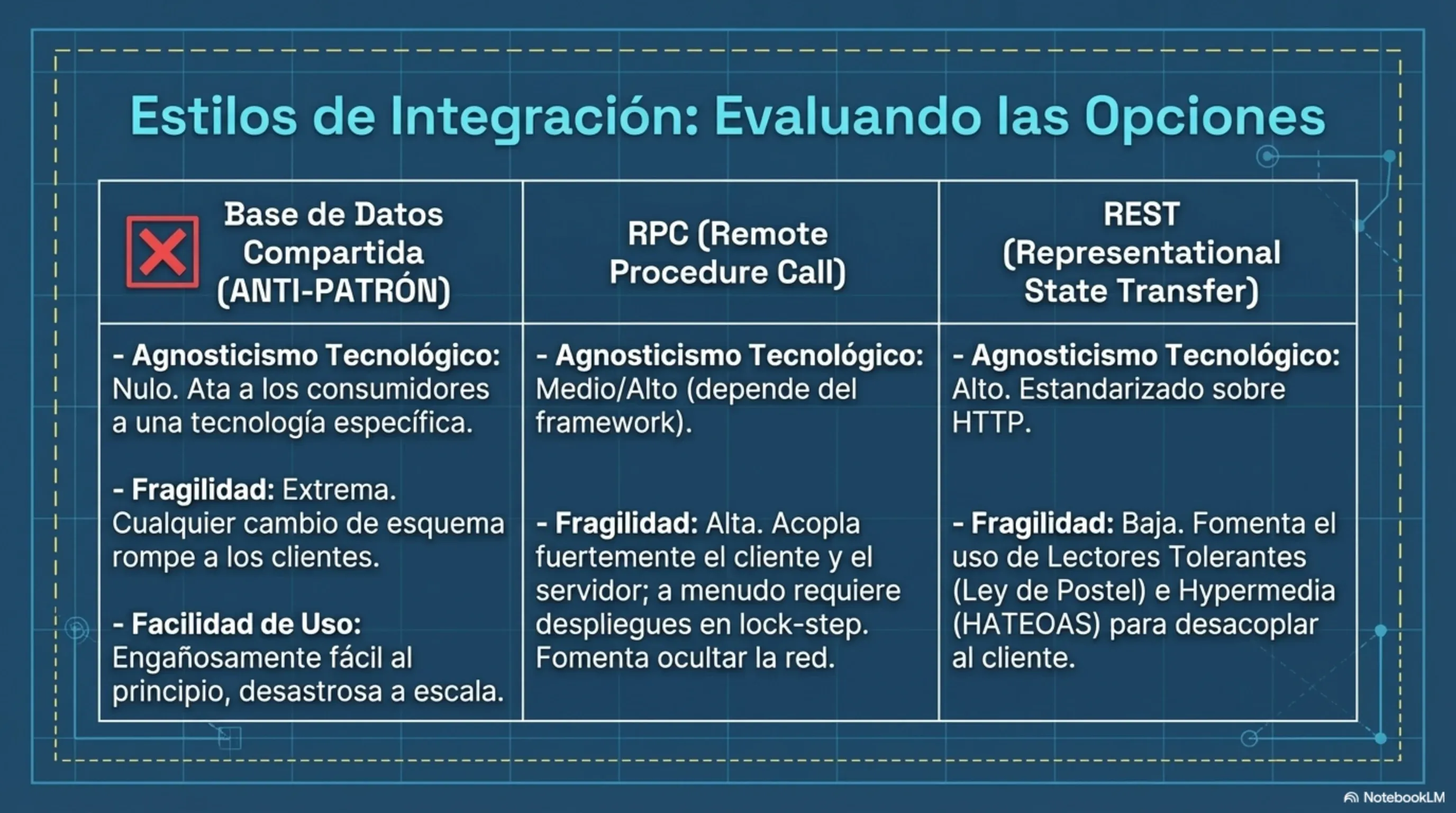
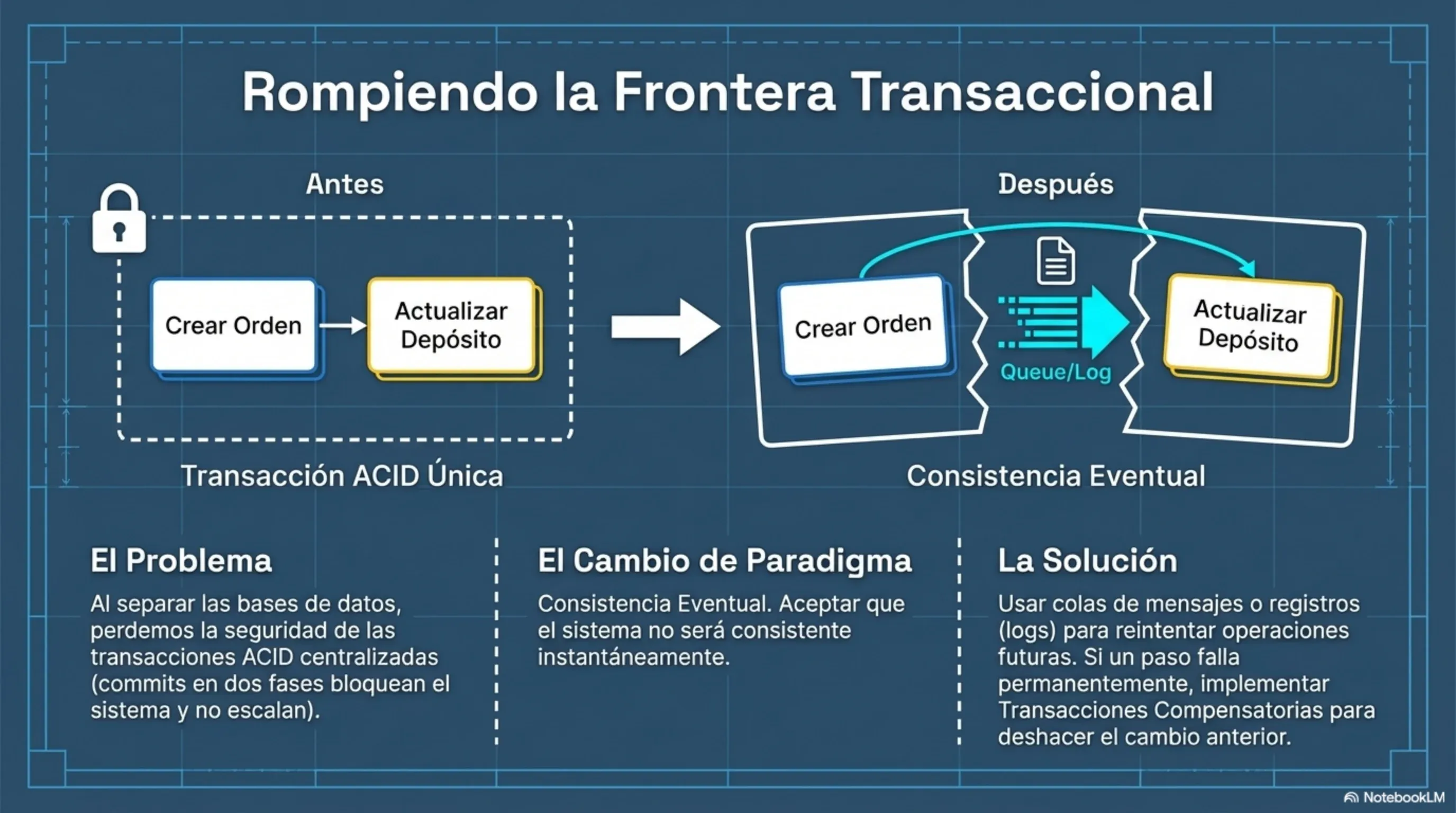
Newman’s inviolable rule: each microservice is the sole owner of its data. No other service touches its database directly.
Data flow: input, process, output
Each service can be understood as an autonomous state machine that manages a business capability.
Input can be synchronous, through HTTP/REST, or asynchronous, through events in a queue. Synchronous calls are simple and traceable but create temporal coupling. Asynchronous events increase resilience but require better tracing and retry strategy.
Process should expose business intentions, not CRUD wrappers. A service should offer operations like ApproveOrder, CancelOrder, or ApplyDiscount. The business logic that makes the product different lives there.
Output can be an immediate response and an event published to the bus, such as OrderApproved or StockUpdated, so other services can react without tight coupling.
Orchestration vs choreography
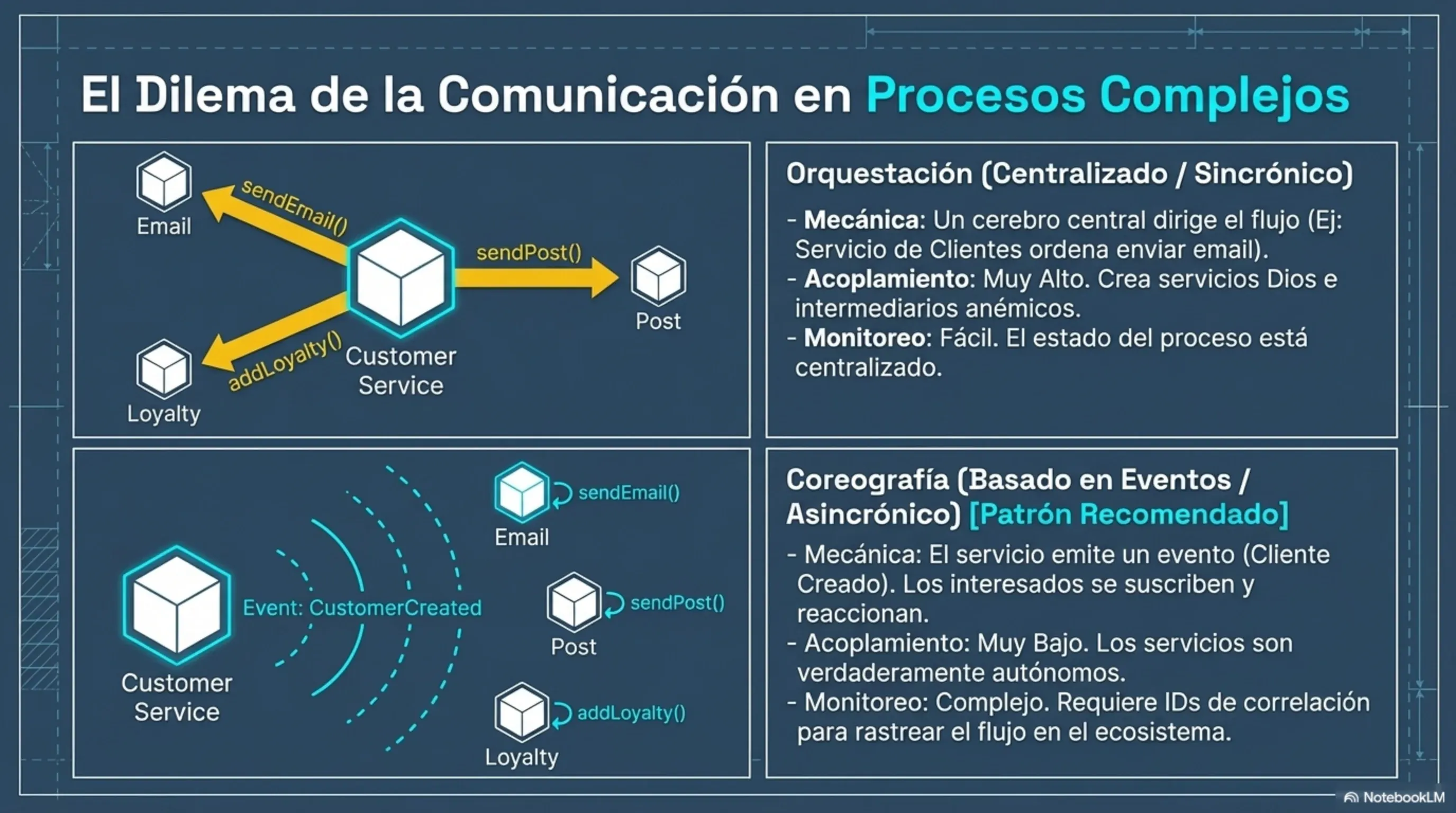
Orchestration uses a director service that knows the process order and tells every service what to do. It is easier to visualize, but the director can become the new monolith.
Choreography lets each service react to events. When payments publishes PaymentConfirmed, shipping listens and prepares the package. Nobody tells it what to do; it knows its responsibility.
Newman strongly favors choreography. The cost is that you must invest in correlation IDs and distributed monitoring. Without them, debugging becomes nearly impossible.
API versioning and Postel’s Law
Distributed API changes are surgical operations. An incompatible change in one service can silently break all consumers.
Postel’s Law is useful here: be conservative in what you send and liberal in what you accept. Services should tolerate additional fields in incoming messages and avoid removing response fields without notice.
When breaking changes are unavoidable, run old and new endpoints side by side long enough for consumers to migrate.
Patterns you cannot ignore
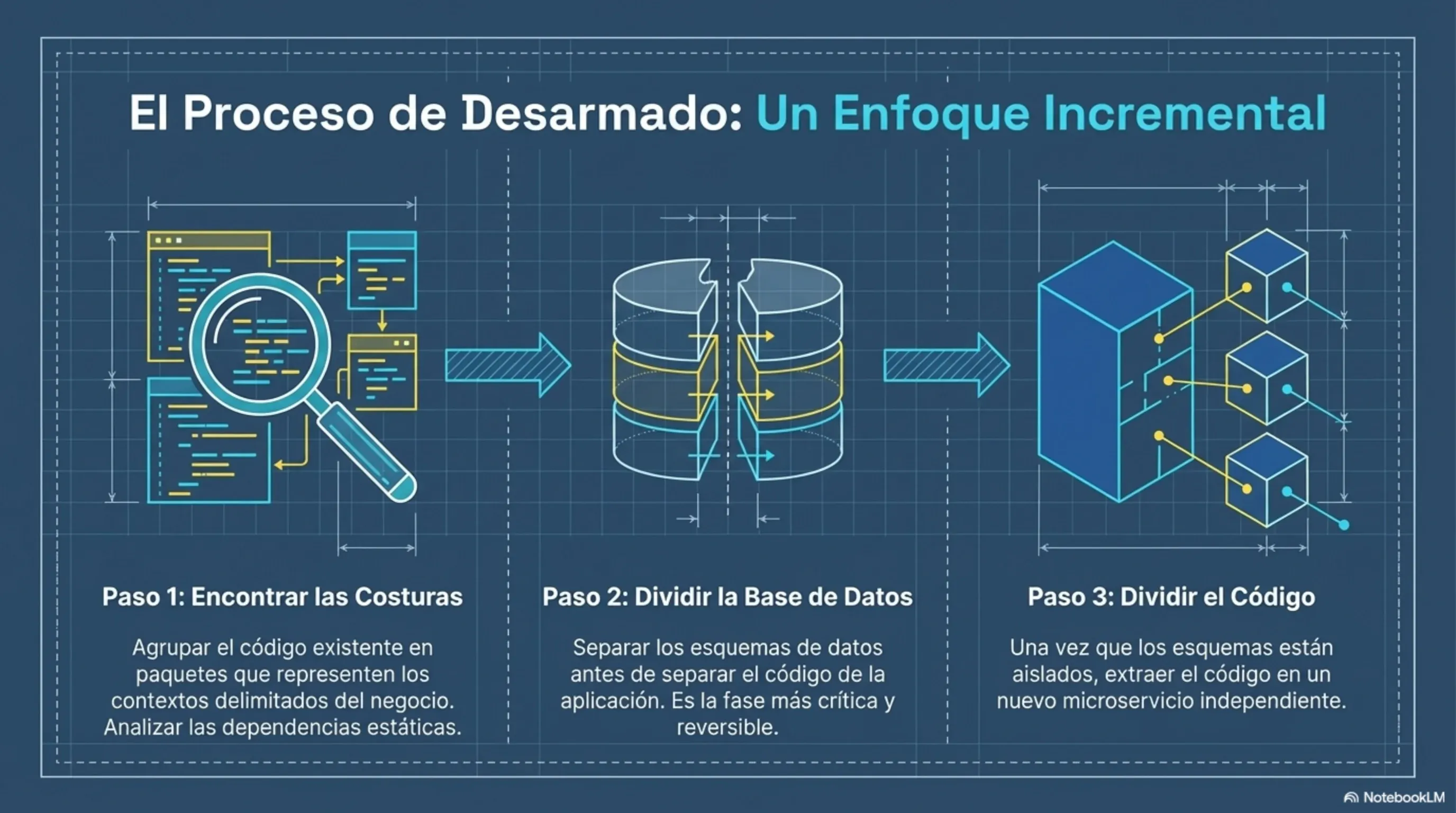
Strangler Fig
If you already have a production monolith, do not rewrite it from scratch. Intercept calls at the boundary and gradually route specific capabilities to new services. The old monolith keeps running while responsibilities move out.
Circuit Breaker
A service that depends on another service inherits its fragility. A circuit breaker detects repeated failures and opens the circuit, returning an error or fallback immediately instead of waiting for a dependency that may never respond.
Together with timeouts and bulkheads, circuit breakers form the minimum safety layer for graceful failure.
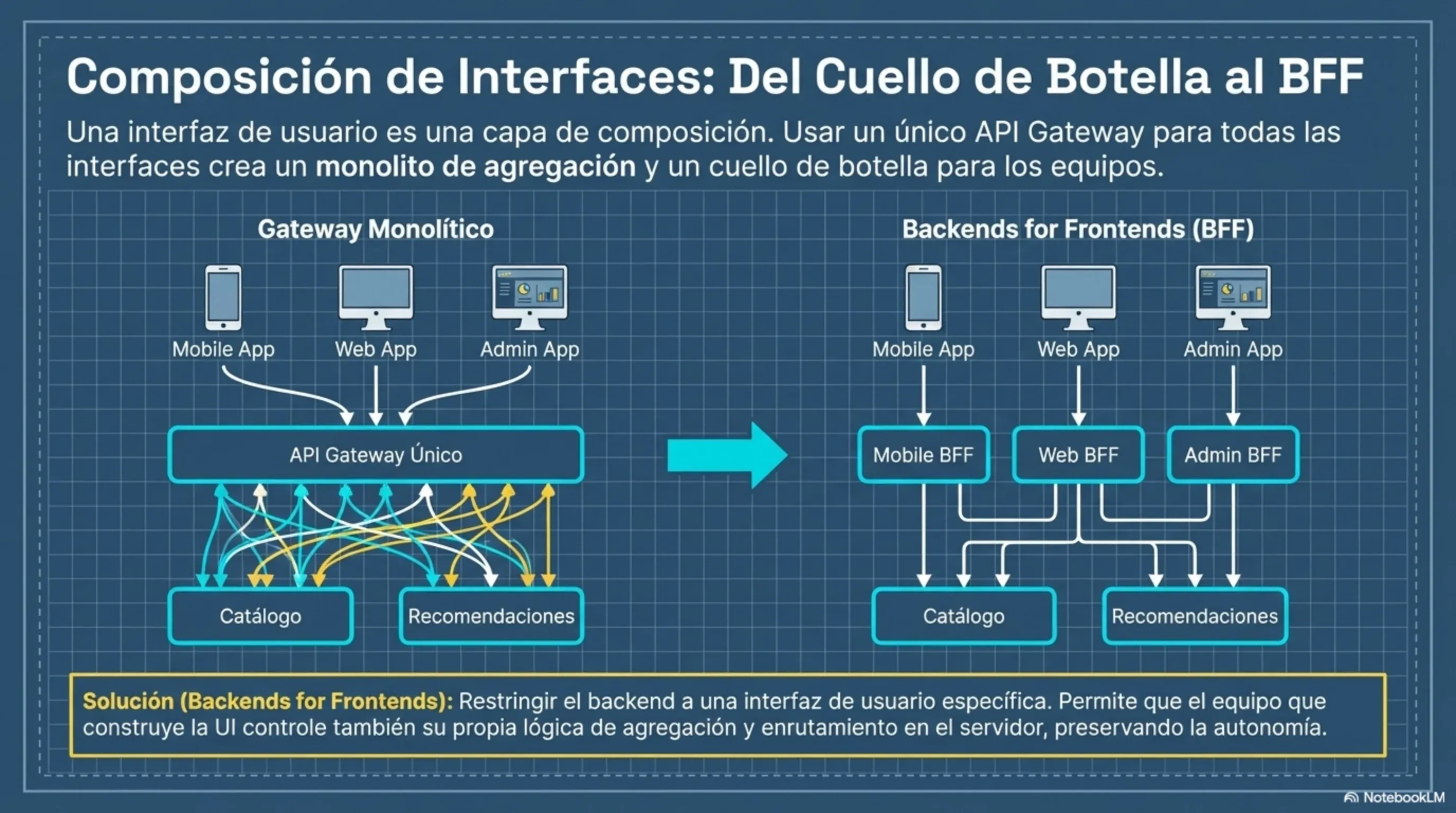
Backend for Frontend
One API designed for mobile, desktop web, and public consumers usually becomes mediocre for all of them. A BFF creates one facade per client type, reducing payloads and shaping exactly the response each interface needs.
CQRS
Analytical dashboards should not JOIN across databases owned by different services. CQRS creates a separate read model updated from events. Commands go to write services; queries go to optimized read stores.
Service discovery, testing, and observability
In distributed systems, hardcoded IPs do not work. DNS is universal but cached. Dynamic registries such as Consul or Eureka react faster but become critical infrastructure.
End-to-end tests become fragile and slow when many services must be deployed together. Consumer-Driven Contracts, with tools like Pact, verify provider behavior against consumer expectations before production.
Observability is non-negotiable. A minimum stack includes structured centralized logs, correlation IDs, semantic monitoring, and health checks for every service.
When not to use microservices
Do not use microservices if:
- Your domain is unclear.
- Your team is small.
- The system does not need to scale in independent parts.
- You do not have a mature automation culture.
In those cases, a well-modularized monolith is often the better architecture.
Architectural decision summary
| Decision | Option A | Option B | Newman’s recommendation |
|---|---|---|---|
| Flow coordination | Orchestration | Choreography | Choreography |
| Communication | Synchronous REST | Asynchronous events | Async when possible |
| Service discovery | DNS | Dynamic registry | Dynamic registry for large systems |
| Integration testing | E2E | Consumer-Driven Contracts | CDCs |
| Deployment | Multiple services per pipeline | One pipeline per service | One pipeline per service |
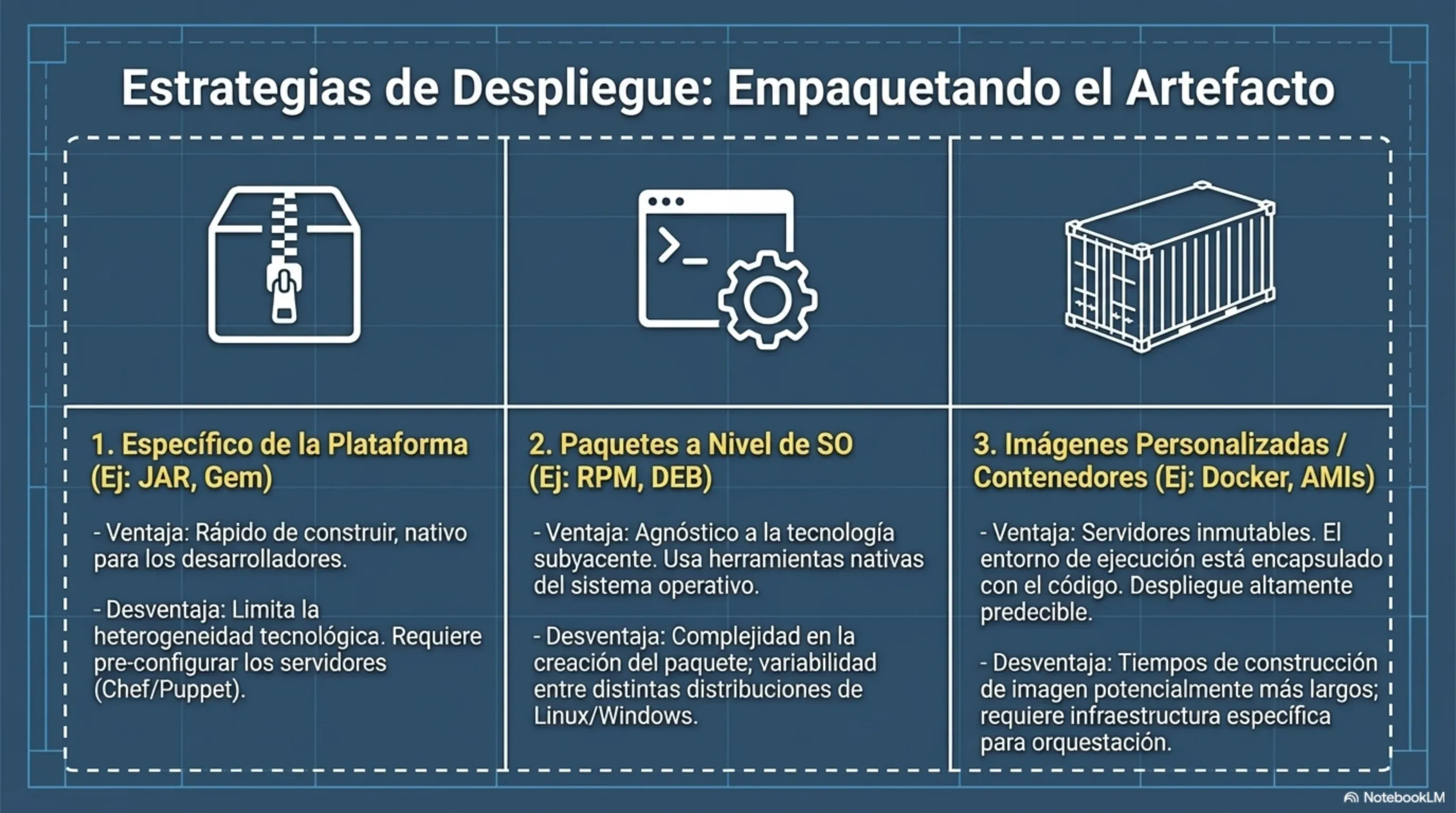
| Infrastructure | Shared server | Container per service | Container per service |
| Shared code | Central libraries | Service templates | Service templates |
Next step
If you are evaluating whether your current system needs architectural restructuring, or if you are designing a new one and want to avoid common mistakes, I can help you analyze what you have and define the right strategy.
The answer is not always microservices. Sometimes it is a better modular monolith. Sometimes it is extracting one specific service. The difference can be months of work and significant migration cost.
Contact us through WhatsApp or email, and we can start with a free diagnosis.
Sources and references
- Building Microservices, 2nd Edition — Sam Newman (2021)